Davis
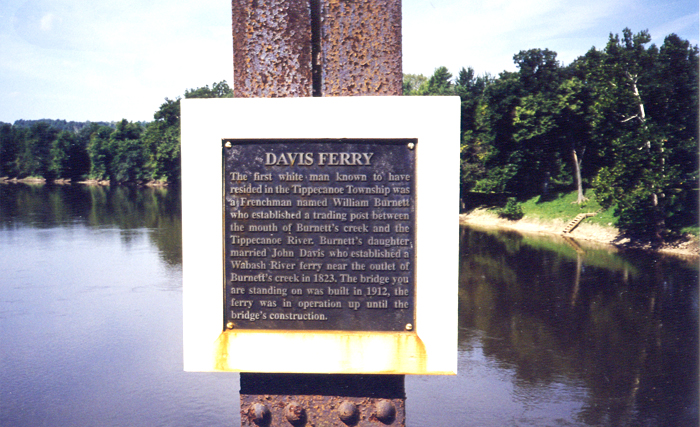
Ferry, Part of History
"Davis
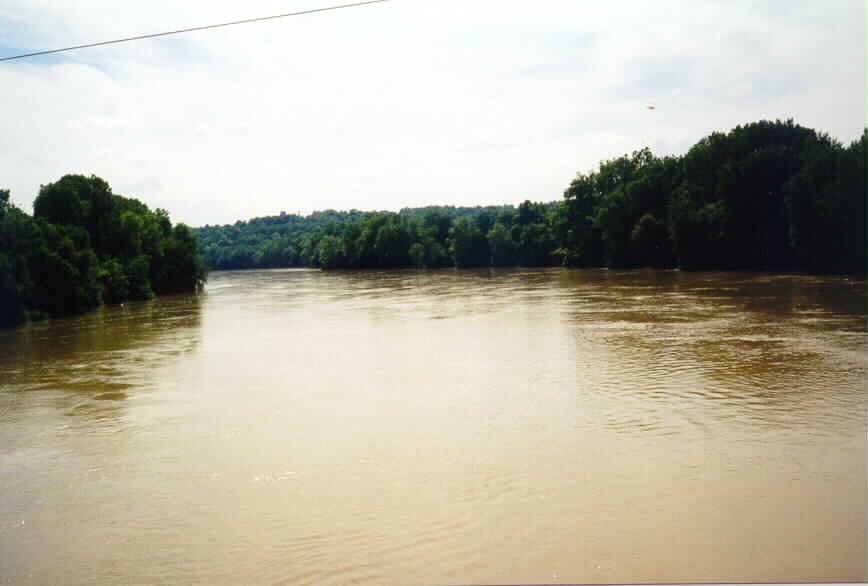
Ferry. On a map, it appears as a
placid little bend in the Wabash
River. But history shows this
point to have been the scene of
activity since the beginnings of
Tippecanoe County and source of
controvery more than once.
The story of Davis Ferry goes back to
1823 or 1824, when John Henry Davis
settled on the north bank of the
Wabash with his wife, Nancy Burnett
Davis.
Nancy, whose mother, Kaukeama, was an
Indian princess, had come into
possession of 640 acres of land in
what is known as "Burnette's Reserve."
It was the custom of the newly formed
United States government to grant
lands acquired from the Indians
through purchase or treaty to the
children of mixed marriages between
Indians and whites.
This was one means of rewarding the
parents for aid and loyalty to the
American colonies. The reserve
had been granted to the children of
Kaukeama and her husband, William
Burnett.
On the four or so acres of land
bordering the Wabash at the particular
bend, John and Nancy Davis built a log
cabin, believed the first in what is
now Tippecanoe Township. Davis
set up a grist mill and a still.
He also began operating a ferry.
Then, as now, the crossing served as
the only direct link between Lafayette
and Battle Ground, as well as the
northern part of Tippecanoe
County. In those days, it also
was on the road to Logansport.
The name Davis Ferry has stuck with
the location right up to the present,
though the Davises are long since gone
and a bridge has replaced the ferry.
John H. Davis manned the operation
only about seven years. He died
July 30, 1830, at the age of 43,
followed three months later by
31-year-old Nancy. The pair left
behind two small sons, Richard H.,
aged 7, and his older brother, William
B.
The death of Davis and the threat of
the demise of ferry operations
evidently was of grave concern to
county residents.
On March 2, 1830, during Davis' last
illness, 20 some citizens presented a
petition to the County Commissioners
asking that the ferry be kept in
operation somehow. "Wee the
undersiners think it is gratly
needed, for thar is times in the
year that his river cannot be
crossed with ferrying. Wee
think it will bee of grat serves to
us and the community," the
document said.
Obviously a ferry in this key location
could not be allowed to remain idle
for long. So in 1831, the County
Commissioners authorized Samuel A.
Dickson to run it. Upon his
death a little over a year later, the
operation was taken over briefly by
pillar of the community whose name
seems to pop up everywhere in the
county history of the era, Peter
Weaver.
Meanwhile, a man named Jacob Walker
had been appointed guardian of the two
Davis boys and their estate.
Walker industriously set about to
manage and invest the property to
which the children had fallen
heir. He saw to it that the
ferry and the land produced income to
bring up the boys and provide for
their education.
In 1838, Walker leased the riverfront
part of the Davis property to Edmunds
an John T. Huff, two brothers, who
operated the ferry for four or five
years. Several descendants of
the Huffs still live in the Lafayette
area, though not all bear the name
Huff.
The enterprising John T. Huff took
advantage of a state law passed in
1844, making it legal for anyone
owning land on a stream bank opposity
a ferry to enjoy mutual privileges of
that operation by charging fares for
passengers embarking from his side of
the stream. Huff bought the land
on the south bank of the Wabash and ,
in effect, went into competition with
the original ferry.
It appears that a ferry was in
operation at this site up until the
building of the old Davis Ferry Bridge
in 1912. Though the activity on
the riverbank has slowed with the
coming of a bridge, this crossing at a
meandering bend in the Wabash River
has been a vital link in the growth of
Tippecanoe County for 150 years."
|